
How to Get More Reviews and Testimonials for Your Business Online
Online reviews and testimonials are strong trust signals. Here's a practical guide to getting more of them, from timing your requests to making the process easy for your clients.

Hans Allí
How to Get More Reviews and Testimonials for Your Business Online
Why Reviews Matter More Than You Think
Most Philippine businesses treat reviews as a nice-to-have. Something that happens on its own if you do good work. That thinking costs you money.
Reviews are one of the strongest trust signals online. They influence whether someone clicks your Google listing, whether they pick you over a competitor, and whether Google even shows your business in local search results. For service-based businesses in the Philippines, where word-of-mouth has always driven growth, online reviews are the digital version of that referral from a friend.
The problem is that satisfied customers rarely leave reviews unprompted. Unhappy ones do. If you are not actively building your review count, you are letting your online reputation be shaped by the few people who had a bad day.
Here is how to fix that.
When to Ask for a Review
Timing is everything. Ask too early and the customer has not experienced enough to comment. Ask too late and they have moved on.
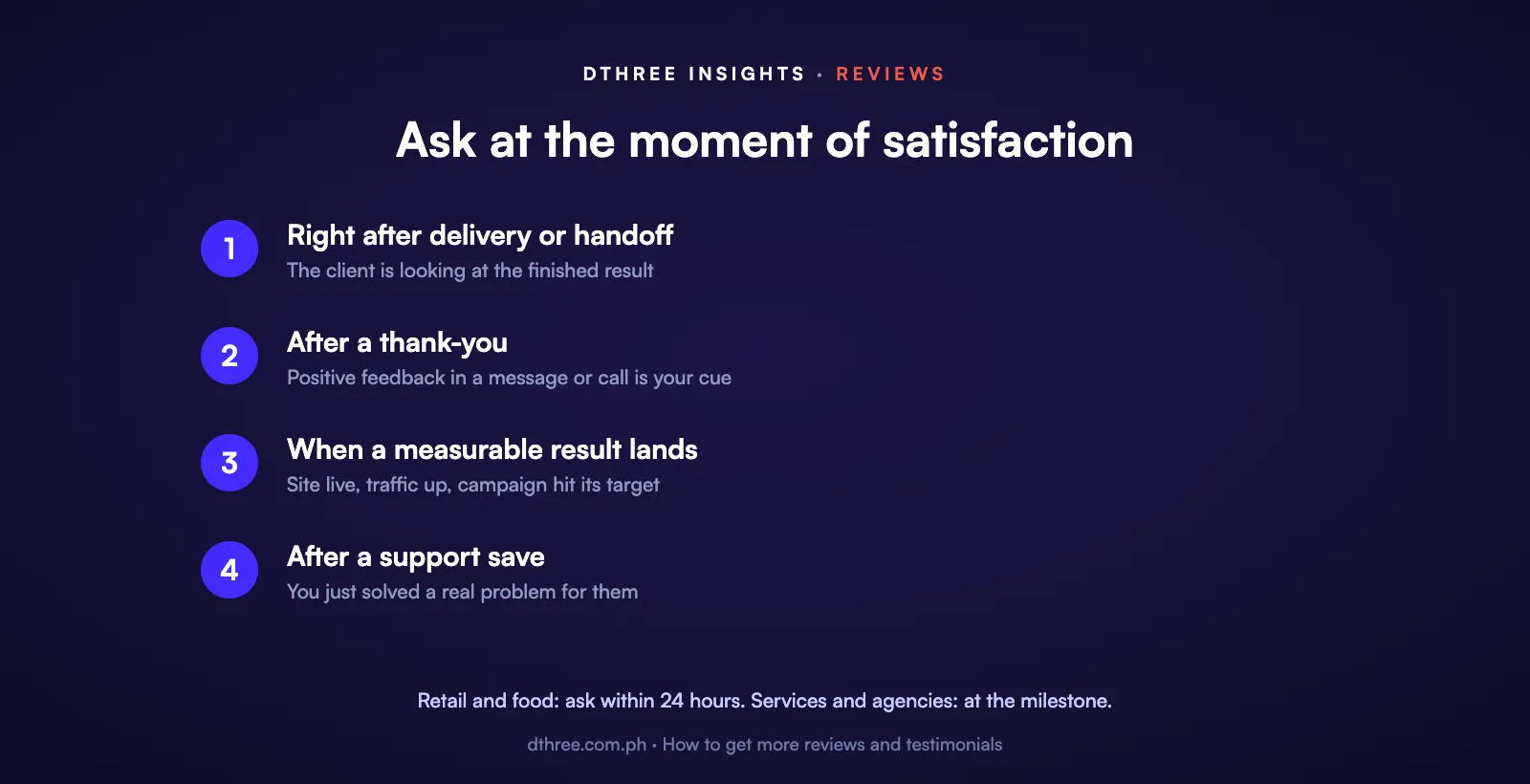
The best time to ask is right after a moment of satisfaction. That could be:
- Right after project delivery or handoff, when the client is excited about the result
- After a customer thanks you or gives positive feedback in a message or call
- When a measurable result lands (a website goes live, traffic increases, a campaign hits its target)
- After a successful support interaction where you solved a real problem
For retail and food businesses, the window is shorter. Ask within 24 hours of purchase or visit. For service businesses and agencies, ask within a week of a key milestone.
The Follow-Up Sequence
One ask is rarely enough. People are busy. They mean to leave a review and then forget. Plan for at least two touchpoints:
- First ask: Personal message (Viber, email, or in-person) right after the satisfaction moment
- Second ask: A follow-up 3 to 5 days later if they have not posted yet, framed as a gentle reminder with a direct link
Do not ask a third time. Two is persistent. Three is annoying.
How to Ask Without Being Awkward
The number one reason businesses do not ask for reviews is that it feels uncomfortable. Get over it. You are not begging. You are giving a happy customer an easy way to say something nice.
Keep the ask simple and specific. Do not say "please leave us a review." Instead, try:
- "Would you mind sharing your experience on Google? It really helps other businesses find us." (for B2B)
- "If you have a minute, a Google review would mean a lot to us. Here is the link." (for B2C)
- "We are building up our reviews on [platform]. Since you had a good experience, would you be open to posting a quick one?"
Notice the pattern: acknowledge their positive experience, name the platform, and explain briefly why it matters. Filipino customers are generally willing to help if you ask directly and politely. Most just need to be asked.
What Not to Do
- Never offer discounts or incentives in exchange for reviews. Google prohibits this and can remove your reviews or penalize your listing.
- Never ask for a "5-star review." Ask for an honest review. Coaching the rating violates platform guidelines.
- Never buy fake reviews. It is obvious, it damages trust, and platforms are getting better at detecting them.
Make the Process as Easy as Possible
Every extra step between your ask and the published review is a drop-off point. Your job is to remove friction.
For Google Business Profile
Google Business Profile is the most important review platform for Philippine businesses that serve a local market. Here is how to make it easy:
- Generate your direct review link from your Google Business Profile dashboard (under "Ask for reviews"). This link takes customers straight to the review form, no searching required.
- Shorten the link using Bitly or a similar tool so it is easy to share via Viber or SMS.
- Create a QR code that links to your review page. Print it on receipts, packaging, table tents, or your office wall.
- Add the review link to your email signature, your website footer, and your post-project thank-you emails.
For Facebook
Facebook recommendations still carry weight in the Philippines, where Facebook penetration is among the highest in the world. Direct customers to your Facebook Page's Reviews tab. If you run a Facebook Page for your business, make sure the Reviews section is turned on in your Page settings.
For Industry-Specific Platforms
Depending on your business, reviews on niche platforms can be more valuable than Google for certain audiences:
- Agencies and tech companies: Clutch, Google Business Profile, and LinkedIn recommendations
- Restaurants and cafes: Google, Facebook, Zomato, and TripAdvisor (especially if you serve tourists)
- Hotels and travel: TripAdvisor, Booking.com, Agoda, Google
- E-commerce: Shopee and Lazada product reviews, plus your own website testimonials
- Healthcare and professional services: Google Business Profile and your own website
Pick two or three platforms that matter most for your industry and focus there. Do not spread yourself thin across every review site.
Responding to Reviews (Yes, All of Them)
Collecting reviews is only half the work. Responding to them is the other half, and most businesses skip it entirely.
Responding to Positive Reviews
A quick, genuine response to a positive review does three things: it shows the reviewer you appreciate them, it signals to future customers that you are engaged, and it gives Google another data point that your business is active.
Keep responses short and personal. Mention something specific about the customer's experience or project if you can. Avoid copy-paste responses that look robotic.
Responding to Negative Reviews
This is where most businesses panic. Do not. A negative review handled well can actually build trust.
- Respond promptly, within 24 to 48 hours.
- Acknowledge the issue without being defensive. Even if the customer is wrong, arguing in public never looks good.
- Take the conversation offline. Provide a direct contact (email or phone) so you can resolve the issue privately.
- Follow up. If the issue gets resolved, politely ask if they would consider updating their review.
Potential customers reading your reviews will judge you more on how you handle complaints than on the complaint itself. A business with a few negative reviews and thoughtful responses looks more trustworthy than a business with nothing but perfect scores.
Repurposing Reviews and Testimonials
Reviews should not just live on Google or Facebook. Pull the best ones into your marketing.
On Your Website
- Add a testimonials section to your homepage and key service pages. Use real names and company names with permission.
- Create a dedicated testimonials or case studies page.
- Place relevant testimonials near calls to action. A quote from a happy client right above your contact form reduces hesitation.
In Your Sales Materials
- Include client quotes in proposals and pitch decks.
- Add them to email nurture sequences.
- Use them in social media content. A simple graphic with a client quote performs well on Facebook and LinkedIn.
Video Testimonials
If you can get a client to record a short video testimonial, that is gold. It does not need to be professionally produced. A 30 to 60 second selfie-style video from a client's phone, posted to your social channels and embedded on your site, carries more weight than a page full of text quotes. Filipino business owners tend to be generous with video testimonials when asked in person after a successful project.
Reviews, SEO, and AI Search Visibility
Here is where reviews connect directly to your search performance.
Google Local Pack and Maps
Google uses review quantity, quality, and recency as ranking factors for local search results (the map pack that appears at the top of local queries). A business with 80 recent reviews will almost always outrank a competitor with 12 old ones, all else being equal. For Philippine businesses targeting local customers, this is one of the fastest ways to improve visibility.
Rich Snippets and Star Ratings
When you add structured review markup (schema) to your website, Google can display star ratings directly in search results. This increases click-through rates significantly. If your website does not have review schema implemented, that is something worth fixing. On-page SEO improvements like this are straightforward to implement and pay off quickly.
AI Search and Answer Engines
This is the newer and increasingly important angle. AI-powered search tools like Google's AI Overviews, ChatGPT search, and Perplexity pull information from across the web to generate answers. Businesses with strong, consistent review profiles across multiple platforms are more likely to be cited or recommended in AI-generated responses.
When someone asks an AI tool "best web design agency in Manila" or "top restaurants in Makati," the AI is synthesizing data from Google reviews, industry directories, and other sources. Your review profile is part of what feeds those answers. Businesses with thin or nonexistent review profiles are invisible to these systems.
Building a Review System, Not Just a Habit
The businesses that consistently earn reviews are not the ones that remember to ask sometimes. They have a system.
- Assign ownership. Someone on your team (or you, if you are a solo operator) is responsible for review requests.
- Build it into your process. For service businesses, add "request review" as a step in your project closeout checklist. For retail, automate a follow-up message after purchase.
- Track your numbers. Monitor your review count and average rating monthly. Set targets. Even modest goals like "5 new Google reviews per month" compound over time.
- Audit your profiles quarterly. Make sure your Google Business Profile, Facebook Page, and other listings are accurate, complete, and have recent reviews.
Start with Google Business Profile if you have to pick one platform. It has the most impact on search visibility and is where most Filipino consumers check before contacting a business.
Start Now, Not Later
You probably have 5 to 10 happy customers right now who would leave a review if you asked. That is your starting point. Send those messages today. Set up a direct review link. Add a testimonial to your homepage. Build from there.
If you need help setting up review schema on your website, optimizing your Google Business Profile, or building a testimonials section that actually converts, get in touch with us. We help Philippine businesses turn their reputation into a growth channel.


.avif)