
Why every Philippine business needs a professional website in 2026
A Facebook page sits on rented land, and in 2026 the landlord and the search engines both changed the rules. Here is why a professional website is the most durable asset a Philippine business can own, with the numbers behind it.

Hans Allí

Why every Philippine business needs a professional website in 2026
The shortlist you never see
Picture a procurement officer at a Manila corporation who needs to hire a web design agency. They shortlist three. Two have professional websites showing their work, their team, and their client results. The third has only a Facebook page. You already know which one gets cut first, and it happens before anyone picks up the phone.
That quiet elimination is happening to Philippine businesses every day, in more categories than web design. It is the real cost of not having a website, and it is why we still tell every business owner the same thing. A Facebook page alone no longer covers you.
Here is the case, with the numbers behind it.
The country your customers already live in
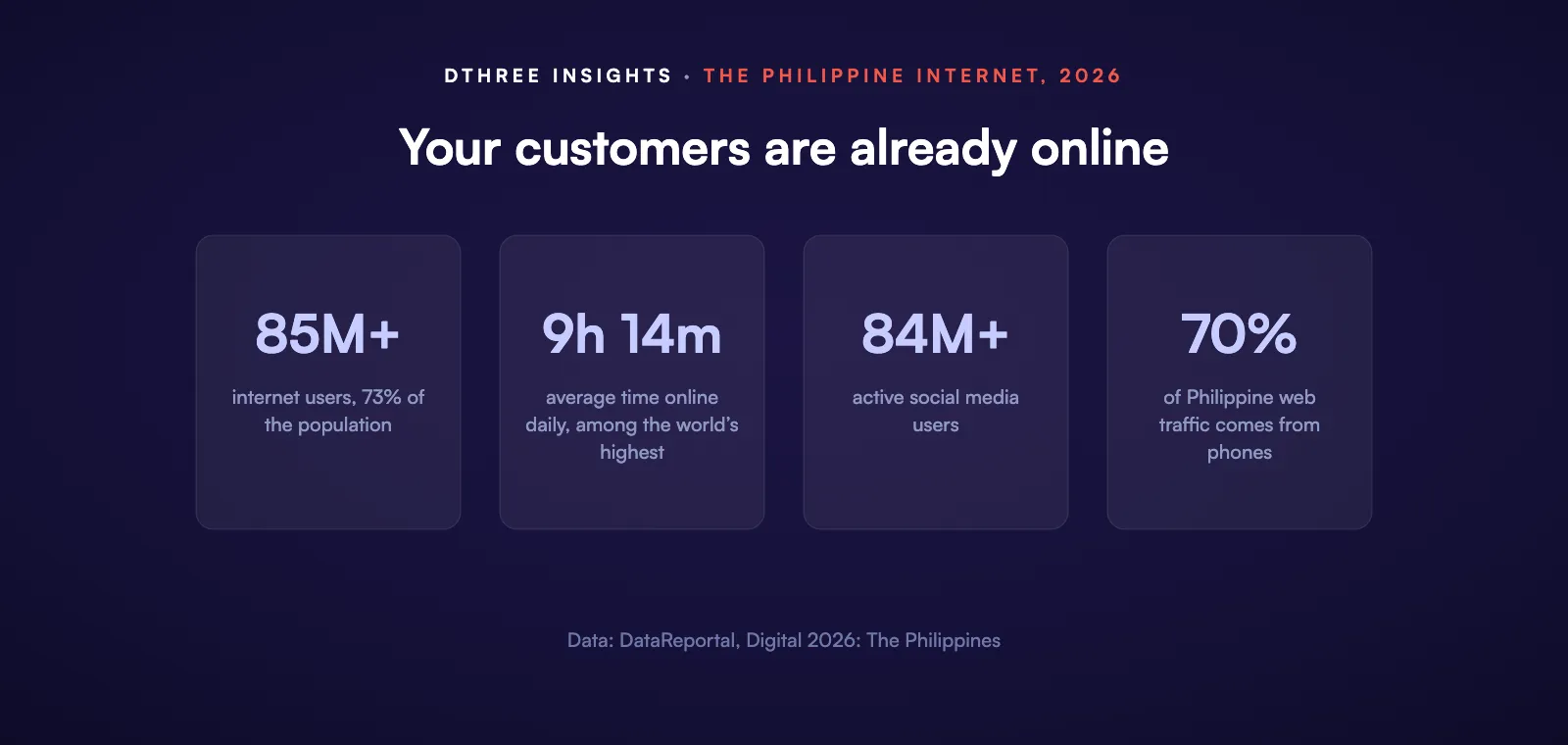
The Philippines is one of the most digitally connected nations on the planet. Over 85 million internet users, roughly 73% of the population. An average of 9 hours and 14 minutes online each day, consistently among the highest in the world. More than 70% of web traffic comes from smartphones. Social media usage stays enormous at over 84 million active users, and the digital economy is projected to reach $35 billion by 2028.
Those are not abstract figures. They are your customers, searching and comparing and deciding, right now, mostly on a phone.
Why a Facebook page is rented land
Social media has its place, and we build strategies around it. But using it as your whole online presence has hard limits, and they are structural, not cosmetic.
You do not own the platform. Facebook does. An algorithm change can halve your reach overnight. An account can be suspended without warning. Your page sits on rented land, and the landlord can change the rules whenever it likes.
Search barely sees you. When someone Googles "web design agency Manila" or "best restaurant in Makati," Facebook pages rarely surface. Google favors websites because they carry richer, more structured content. Without one, you are close to invisible to the people actively looking for exactly what you sell.
You do not control the experience. On Facebook, the layout and the journey are the platform's, not yours. You cannot build a custom landing page, present a portfolio the way it deserves, or walk a visitor from curiosity to inquiry on your own terms.
AI search reads websites, not pages. In 2026, tools like Google's AI Overviews, ChatGPT, and Perplexity answer questions directly, and they pull those answers overwhelmingly from websites. No website with well-structured content means no presence in the fastest-growing search channel there is.
Credibility is decided in seconds
Stanford research found that 75% of people judge a company's credibility on its website design alone. In the Philippines, where trust and reputation carry extra weight in business, that judgment lands even harder.
A professional website tells a visitor several things at once. That the business is real and established. That it takes itself seriously. That its services, its team, and its contact details are open and easy to find. And through client results and case work, that other people have trusted it and been glad they did. Go back to that procurement officer. The site is doing the reassuring before you ever meet.

The salesperson who never clocks out
A physical office closes at six. A Facebook page waits for someone to reply. A well-built website works around the clock, catching leads while you sleep and guiding visitors toward action.
It does that through a few deliberate things. Clear calls to action on every page, "Get a Free Quote" or "Book a Consultation," that turn a passive reader into an inquiry. Contact forms and live chat so no interested visitor leaves without a way to reach you. And content, through service pages and blog posts, that pulls in people already searching for what you do, which is far more targeted than competing for a scroll in a crowded feed.
SEO, the channel that compounds
Search Engine Optimization is how your site gets found on Google. Unlike paid ads, which stop the moment you stop paying, SEO builds value that compounds. A well-made blog post can keep bringing in visitors for years.
For local businesses this is especially strong. Search "accounting firm Quezon City" or "wedding planner Cebu" and Google ranks on relevance, proximity, and site quality. Businesses with optimized websites and Google Business Profiles consistently outrank the ones without.
The fundamentals that get you there: keyword-aware titles and descriptions, page loads under three seconds, mobile-responsive design, structured data that helps search engines read your content, genuinely useful content that answers real questions, and secure hosting with SSL.
GEO, the frontier most businesses are missing
Beyond SEO there is a newer discipline: Generative Engine Optimization. As AI search grows, the way people find you is changing at the root.
Instead of scanning blue links, people ask an assistant, "What is the best web design agency in Manila for small businesses?" The AI then stitches an answer together from multiple sites. To be one of them, your site needs clear, authoritative answers to common questions, specific data and concrete examples, content structured with clean headings and Q and A, your location mentioned naturally, and thorough coverage of the topics you own. The businesses optimizing for SEO and GEO now will hold a real advantage as AI search keeps growing here.
Having a website is the floor. An effective one is the work.
A website is the minimum. An effective website is what actually moves the business. The difference comes down to a handful of things we get right on every build.
A clear value proposition. Within five seconds a visitor should know what you do, who you serve, and why you. If they have to scroll and hunt for it, they are already leaving.
Mobile-first design. With 70% of Philippine traffic on phones, the site is designed for a thumb first: fast, readable without zooming, easy to tap.
Real speed. 53% of mobile users abandon a site that takes longer than three seconds. On variable mobile connections here, performance is not a technical nicety, it is a business decision.
Content with a job. Every page earns its place. The homepage converts, the service pages explain, the about page builds trust, the blog earns traffic and shows expertise. Nothing exists without a reason.
Design that reflects the brand. Dated templates, inconsistent styling, and generic stock photos quietly cost you credibility. Clean, current, consistent design earns it back from the first second.
What a decade of this looks like
At Dthree Digital we have spent over ten years building for Philippine businesses across every sector, and the pattern is consistent. We have built for educational institutions like Ateneo de Manila University and CIIT Philippines, creating experiences that serve students, faculty, and applicants. We have partnered with the American Chamber of Commerce and World Vision to build platforms that carry a mission and drive engagement.
Across all of it, the businesses that invest in a professional, well-optimized site see real gains in lead generation, brand perception, and engagement. For sector detail, see our work on school and university website design and nonprofit and NGO website design.
What getting started actually involves
If you are ready, here is the honest shape of the work. Planning first: goals, audience, sitemap, and content strategy, and getting this right early is what saves time and money later. Then design, translating your brand into layouts, color, type, and hierarchy. Then development, where it becomes a working site on a reliable platform like Webflow or WordPress, with SEO, mobile responsiveness, and analytics built in. And then maintenance, because a site is not a one-time project. It needs updates, monitoring, and care to keep delivering.
Costs in the Philippines run from around ₱50,000 for a basic professional site to ₱500,000 and up for complex custom work. For the full breakdown, see our guide on how much a website costs in the Philippines in 2026.
The floor keeps rising
In 2026 a professional website is not a luxury. It is where customers find you, weigh you, and decide. It is your credibility, your salesperson, and your most durable marketing asset in one. Whether you are starting fresh or replacing a tired site, the businesses that prioritize this now are the ones that will hold the digital market later.
We have been building effective websites for Philippine businesses for over ten years. Explore our services or talk to us to start planning yours.


.avif)