
By:
Hans Allí

How Philippine Businesses Get Found in AI Search (We Tested It on Ourselves)
Same question, two different answers
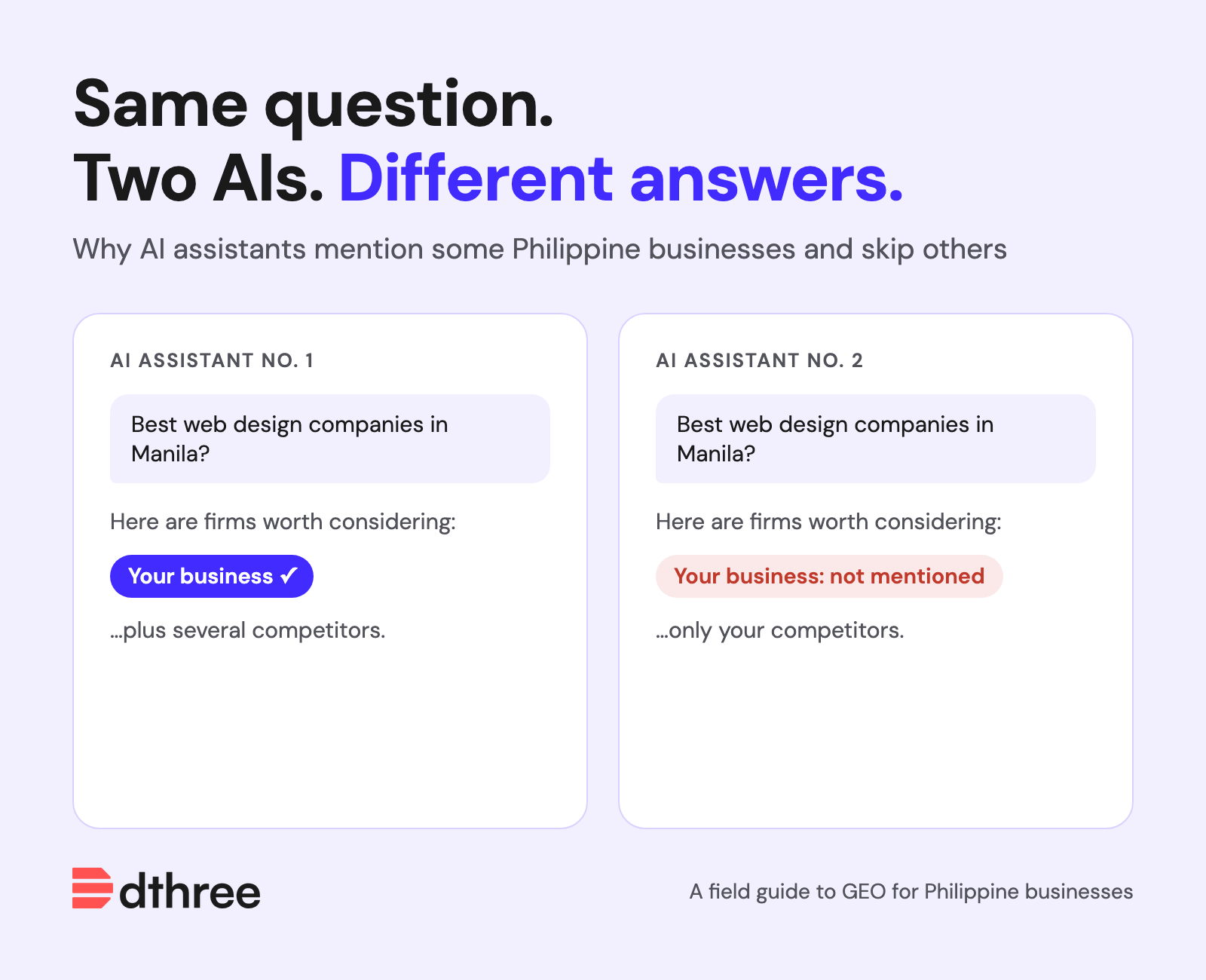
Earlier this month we ran a simple test on ourselves. In a private browser window, with no accounts signed in, we asked the AI assistants the kind of question a prospective client would ask: who are the web design companies worth considering in Manila?
Google's AI Overviews included Dthree Digital. ChatGPT, asked the same thing, often did not mention us at all. Same company, same track record, same website. One assistant recommended us and another acted as if we did not exist.
If you run a business in the Philippines, it is worth sitting with that for a moment. A growing share of your future customers are not scrolling search results anymore. They are asking an assistant for a shortlist, and the assistant is deciding who makes it. If you have never checked what the AI assistants say about your business, that is now part of your marketing whether you asked for it or not.
We went looking for the reason we were missing, fixed what we found, and turned the work into a playbook. This is that playbook, with everything we did on our own site.
Why an AI recommends one business and skips another
The term for this discipline is generative engine optimization, or GEO. Strip away the jargon and it comes down to one question: when an AI assembles an answer, where does it get its facts?
Two places. First, what the model already knows from its training data: news coverage, directories, articles, and pages it has read about you. Second, what it looks up on the spot. Most assistants now run a live web search behind your question and read the top results before answering.
Here is the detail most Philippine businesses miss: the assistants do not all search the same web. Google's AI features lean on Google's index, so if you rank well on Google you tend to surface there. ChatGPT's browsing runs on Bing. If your site is thin or invisible in Bing's index, ChatGPT can be blind to you even while Google recommends you. That single difference explained most of our own gap.
What we did on our own site
Rather than write about GEO in theory, here is the actual work we shipped on dthree.com.ph, in order.
1. We checked whether AI crawlers could read the site
Before anything else, confirm you are not blocking the crawlers that feed these systems. We verified our robots.txt allows the AI crawlers and that the sitemap loads cleanly. Ours were fine, which told us something useful: the gap was not technical. Plenty of sites fail here, some without knowing, because a developer once blocked every bot that was not Google.
2. We registered the site with Bing Webmaster Tools
Since ChatGPT reads the web through Bing, Bing's view of your site suddenly matters far more than its search share ever suggested. We set up Bing Webmaster Tools, imported the site from Google Search Console, and submitted the sitemap. Bing now also has an AI Performance report that shows when your content is used in AI answers, which turns guesswork into a number you can track. This is the highest-leverage twenty minutes on this list.
3. We made the site say plainly what we are
AI systems quote pages that state facts cleanly. Marketing lines like "crafting digital excellence" give an AI nothing to work with. A sentence like "Dthree Digital is a design-led web consultancy in Manila, founded in 2015, serving universities, enterprises, and NGOs" is extractable, quotable, and hard to garble.
We call this an entity block: one plain-language passage that names what you are, where you are, who you serve, and what proves it. Write one for your business and put it on your About page. Boring on purpose. The AI does not reward cleverness, it rewards clarity.
4. We tightened our structured data
Structured data is the machine-readable label on your pages. Ours declares the organization type, founding year, location, services, and contact details, and our FAQ pages carry FAQ markup so direct questions can be lifted straight into answers. If your site has no structured data at all, this belongs near the top of your list. One accurate block beats five conflicting ones.
5. We started fixing our presence off the site
Assistants cross-check. If your website, your Google Business Profile, and the directories describe you three different ways, you blur your own picture. We are building out consistent profiles on the industry directories and keeping name, description, and details identical everywhere. Slower work, still in progress, and it compounds.
What we are seeing so far
Bing's reports are still processing as we write this, so we will not dress early impressions up as results. We will publish the numbers once there is enough data to say something honest. No overnight-results story here; GEO is patient work, which is exactly why starting before your competitors matters.
The five things to do this month
If you run a Philippine business and want the short version:
- Test yourself first. Open a private window and ask ChatGPT, Gemini, and Copilot what they know about your business and who they recommend in your category. You cannot fix what you have not seen.
- Check your robots.txt. Make sure you are not blocking AI crawlers by accident.
- Register with Bing Webmaster Tools. Import from Google Search Console, submit your sitemap, watch the AI Performance report.
- Write your entity block. One plain paragraph on your About page saying exactly what you are, where, and for whom.
- Make your story consistent. Same facts on your site, your Google Business Profile, and every directory that lists you.
What not to do
You will start seeing agencies selling "AI SEO" packages with guaranteed placement in ChatGPT. Nobody can guarantee that; there is no paid placement in these answers to buy. Stuffing pages with "best in Manila" phrasing does not work either, because assistants weigh the same signals of substance that good SEO always has: real content, real proof, consistent facts. Everything in this post is groundwork any honest team can do. The businesses that win AI search will be the ones that made themselves easy to understand, not the ones that found a trick.
Where this fits
None of this replaces the basics. A credible website is still the foundation, and on-page SEO still carries most of the weight, because AI answers are built on top of the same index your rankings live in. GEO is the layer above: making sure that when the assistant reads the web, it understands you and repeats you accurately.
If you want to know how your business currently looks to AI search, we now check entity clarity, structured data, and Bing indexing as part of our website audit. We will tell you plainly whether you have a gap and what closing it involves, the same way we closed ours.


.avif)