
How Much Does a Website Cost in the Philippines in 2026?
A website in the Philippines can cost thirty thousand pesos or over a million. After a decade of quoting these projects, we can tell you the ranges hold, and that the businesses who budget well are the ones who scope before they price. Here is how to place yourself in the range with confidence.

Hans Allí
How Much Does a Website Cost in the Philippines in 2026?
Start with the question behind the question
Nearly every week, a business owner asks us how much a website costs. The ones who end up spending well have one thing in common. They stop treating it as a price question and start treating it as a scope question. So we will give you the ranges, because you came for them, and then show you how to know which one is actually yours.
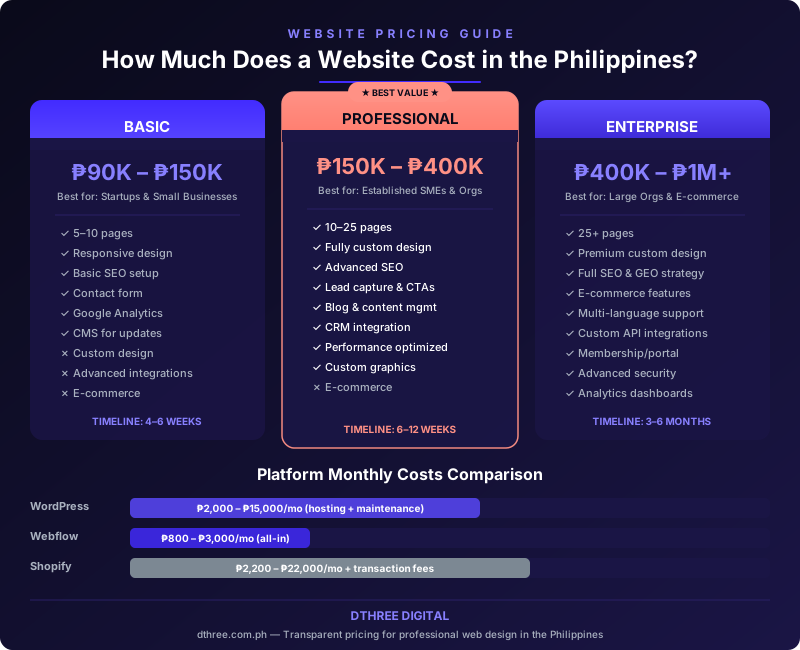
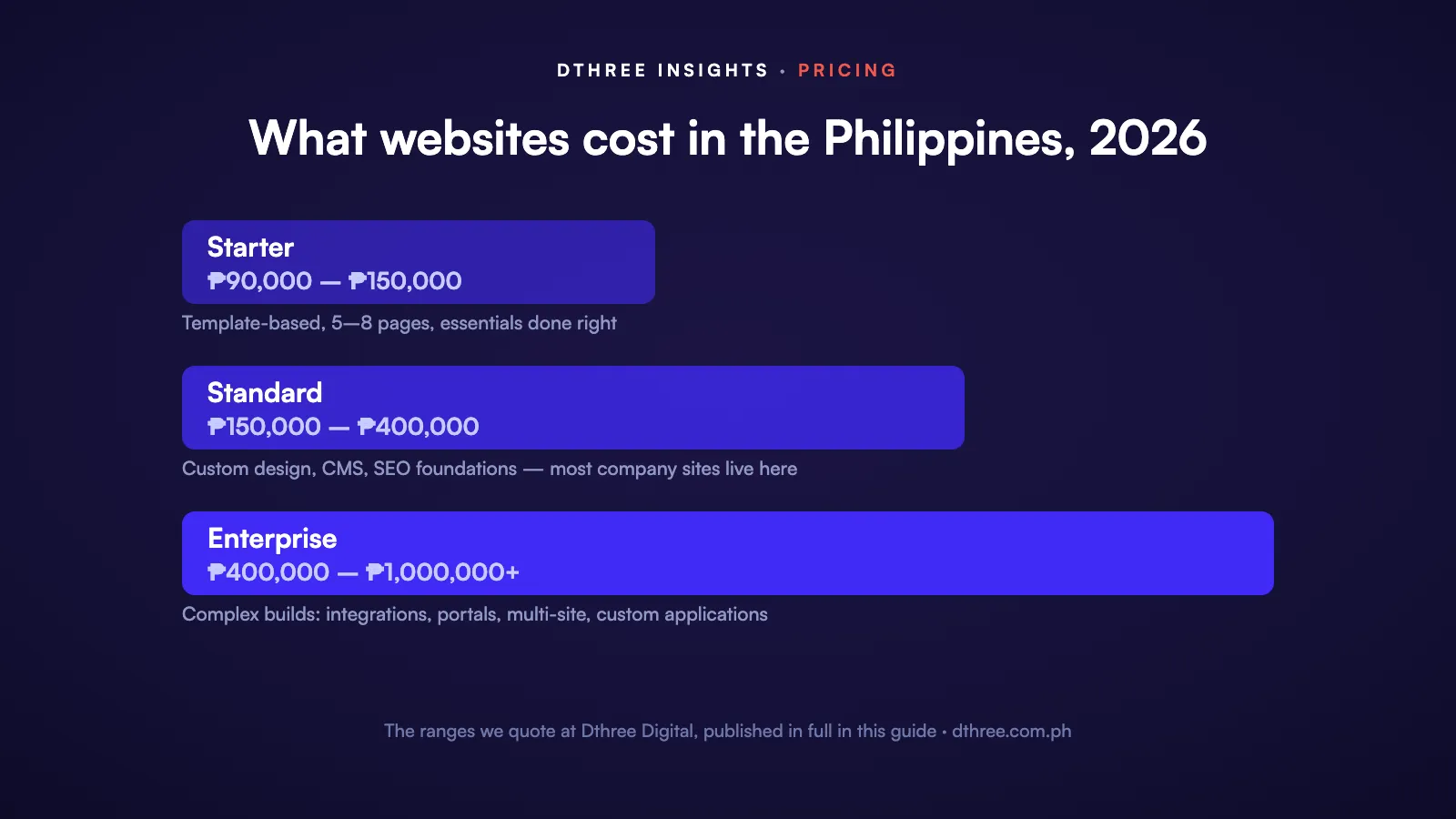
A professionally built business website in the Philippines runs ₱90,000 to ₱150,000 for a basic build, ₱150,000 to ₱400,000 for a custom professional site, and ₱400,000 to ₱1,000,000 and up for enterprise or e-commerce platforms. Simple template sites can start around ₱30,000.
Those ranges are real and we stand behind them. What follows is how to place your project inside them, so the quote you eventually receive holds no surprises.
Why the range is this wide
Website pricing in the Philippines spans from about ₱15,000 to well past ₱1,000,000. That is a huge gap, and it exists because "a website" describes completely different things.
Comparing a five-page brochure site to a custom e-commerce platform with inventory management is like comparing a studio apartment to a ten-story office building. Both are "buildings." The scope, the materials, and the expertise are worlds apart. The price follows the building, not the word.
What moves the number, in order of impact: the type and complexity of the site, the platform or CMS behind it, how much is custom versus templated, the number of pages and features, whether content needs creating, the depth of the SEO and optimization work, and the ongoing maintenance once it is live.
What each investment level actually buys
We have built websites for Philippine businesses for a decade. Here is what the money buys at each level, in plain terms.
Basic business website: ₱90,000 to ₱150,000
For small businesses, startups, and professionals who need a clean, credible presence. Five to ten pages: home, about, services, contact, maybe a simple blog. Responsive design, basic SEO with proper titles and meta descriptions, a working contact form, analytics, and a CMS so you can make small edits yourself.
You are on a customized template or a semi-custom design. It looks professional and works well. It will not carry custom animation, complex integrations, or e-commerce.
Professional business website: ₱150,000 to ₱400,000
This is the tier most established businesses actually need, and the one that earns its keep. Ten to twenty-five pages, a fully custom design built around your brand, deeper SEO, custom visuals, a proper blog, lead capture and CTA work, integrations with your CRM or email tools, performance tuning, and a real content plan.
For most Philippine businesses this is the best value on the board. It pays itself back through better lead generation, stronger brand perception, and a site that pulls its weight instead of just existing.
Enterprise and e-commerce: ₱400,000 to ₱1,000,000 and up
Large organizations, online stores, and anyone with genuinely complex needs. Twenty-five pages and beyond, full custom design and development, custom functionality, e-commerce with product and inventory management and payment gateways, multi-language support, advanced security, member or portal features, API integrations, and real reporting.

The platform changes the math
What you build on shapes both the upfront cost and the bill that keeps arriving. Here is how the three common choices compare for Philippine businesses. (We go deeper in our Webflow vs WordPress vs Shopify breakdown.)
WordPress powers roughly 40% of the web and is still the most common choice locally. Build costs run lower thanks to the theme and plugin ecosystem, but the savings move downstream: plugin updates, security patches, and hosting are a standing cost. Typical build ₱30,000 to ₱500,000, with ₱2,000 to ₱15,000 monthly for maintenance and hosting. See how we approach WordPress builds.
Webflow has become the default for design-led agencies because it pairs visual design freedom with built-in hosting, security, and performance. Build costs typically ₱90,000 to ₱600,000, but the ongoing bill is lower because the platform handles hosting, SSL, and security. Monthly ₱900 to ₱1,600 for a Webflow Site plan, since Webflow folded its old CMS and Business tiers into a single Premium plan in 2026, with far less maintenance overhead. This is our Webflow home ground.
Shopify is purpose-built for selling. Payments, inventory, and shipping come out of the box. Build ₱90,000 to ₱400,000, monthly ₱1,500 to ₱15,000 depending on plan, plus transaction fees on each sale.
The quote is not the cost
This is where budgets quietly break. The number on the proposal is rarely the number you spend. Ask about these upfront.
Content. A beautiful site with weak content is an expensive suit with a stain on it. Copywriting for a ten-page site typically runs ₱15,000 to ₱50,000. Photography and custom graphics add ₱10,000 to ₱30,000.
Domain and hosting. A .com renews for roughly ₱500 to ₱1,500 a year. A .ph costs several times that, somewhere between ₱2,800 and ₱7,800 depending on the registrar, which catches most Philippine businesses out. Hosting depends on platform: WordPress shared hosting starts around ₱1,500 a month, Webflow folds it into the platform fee, and premium hosting for high-traffic sites runs ₱5,000 to ₱15,000 monthly.
SSL. The padlock that makes your site HTTPS is now mandatory for credibility and rankings. Basic SSL is often free with hosting, but extended validation certificates can run ₱3,000 to ₱10,000 a year.
Maintenance. A website is not a one-time purchase. Updates, security monitoring, content, and performance work are ongoing. Professional plans in the Philippines run ₱5,000 to ₱30,000 a month depending on scope, and we break the whole annual bill down in our guide to website maintenance costs.
SEO. Building a site with no SEO is opening a store in a hidden alley. Monthly SEO with a professional agency runs ₱15,000 to ₱50,000 depending on your industry.
The single biggest lever: design complexity
If you want to understand your own quote, look here first. Design is what moves the number most.
A template approach dresses a pre-built design in your brand (₱30,000 to ₱80,000). Semi-custom starts from a framework and customizes heavily (₱80,000 to ₱200,000). Fully custom means every element is designed for your brand, and it is what delivers the results people actually remember (₱200,000 to ₱500,000 and up).
How to get the most for the money
Decide what the site is for before you talk to anyone. The fastest way to waste budget is building without a goal. Your objectives decide which features you need and which are noise.
Have your content ready. The number one cause of delay and overrun is content that is not ready when the build is. Copy, images, and brand assets in hand keep the project on schedule and out of expensive revision cycles.
Choose the team, not the quote. The cheapest proposal is rarely the best value. Look at the portfolio, read the client experiences, understand the process, and ask what happens after launch. A slightly higher investment with a team that will still answer the phone in a year saves money and grief.
Questions we get asked
What is the minimum I should spend? For a website that actually generates results, budget at least ₱90,000 to ₱150,000. Below ₱90,000 usually means real compromises in design, SEO, or function.
How long does it take? A basic site takes four to six weeks. A custom professional site takes six to twelve. Enterprise and e-commerce can run three to six months.
Freelancer or agency? If your website carries your leads and your credibility, an agency is usually the safer investment. You get a team of specialists, designers, developers, SEO, and project management, working together instead of one person carrying all of it.
What you are really budgeting for
In eleven years of building for Philippine businesses, the pattern holds. The projects that pay back are not the cheapest ones. They are the ones scoped honestly, built once, and looked after by a team that is still around a year later. The right site earns its cost back in credibility, leads, and the customers it brings through the door.
We price transparently, and we tell you what you actually need before we tell you what it costs. Talk to us for a free consultation and we will help you plan the build that fits your business.


.avif)